
Let us start with credit where it is due: home workouts are better than they have ever been. YouTube is full of competent instructors, resistance bands cost less than a restaurant dinner, and a person with a living room and some determination can absolutely do themselves good. If that describes your current routine, you are ahead of most of the country, and we mean that.
And yet. We meet a steady stream of people over 60 who did exactly that for a year or two and arrived at our door with the same two-part story: it worked at first, and then it quietly stopped working. The pattern is predictable enough to be worth explaining, because the reasons home training stalls after 60 are specific, and fixable.
What does home training do well?
A genuine list: it removes the commute, costs little, fits into gaps in the day, and for building the basic movement habit it is excellent. Daily walks, band work, bodyweight basics in front of a video, all of this maintains mobility and keeps the engine idling. For people recovering the habit after years away, home is often the friendliest on-ramp there is.
If the choice is home workouts or nothing, choose home workouts every time. The comparison that matters, though, is home versus coached, and there the differences compound with age.
Where does home training stall after 60?
Four places, in rough order of cost:
- Progression quietly stops. Muscle grows when challenge grows, and challenge is exactly what self-directed training stops escalating. The same video, the same band, the same 20 minutes feels like consistency but delivers maintenance at best. After 60, when the body is already inclined to lose muscle each year, a plan that stopped progressing is a plan losing ground politely. It is the progressive overload problem: without a plan that adds, the body stops adapting.
- Load stays too light. The weights most people keep at home top out well below what their legs and back can productively use. Bands and soup cans train endurance; independence is built on strength, and strength needs loads that home setups rarely include, chosen and watched so they stay safe.
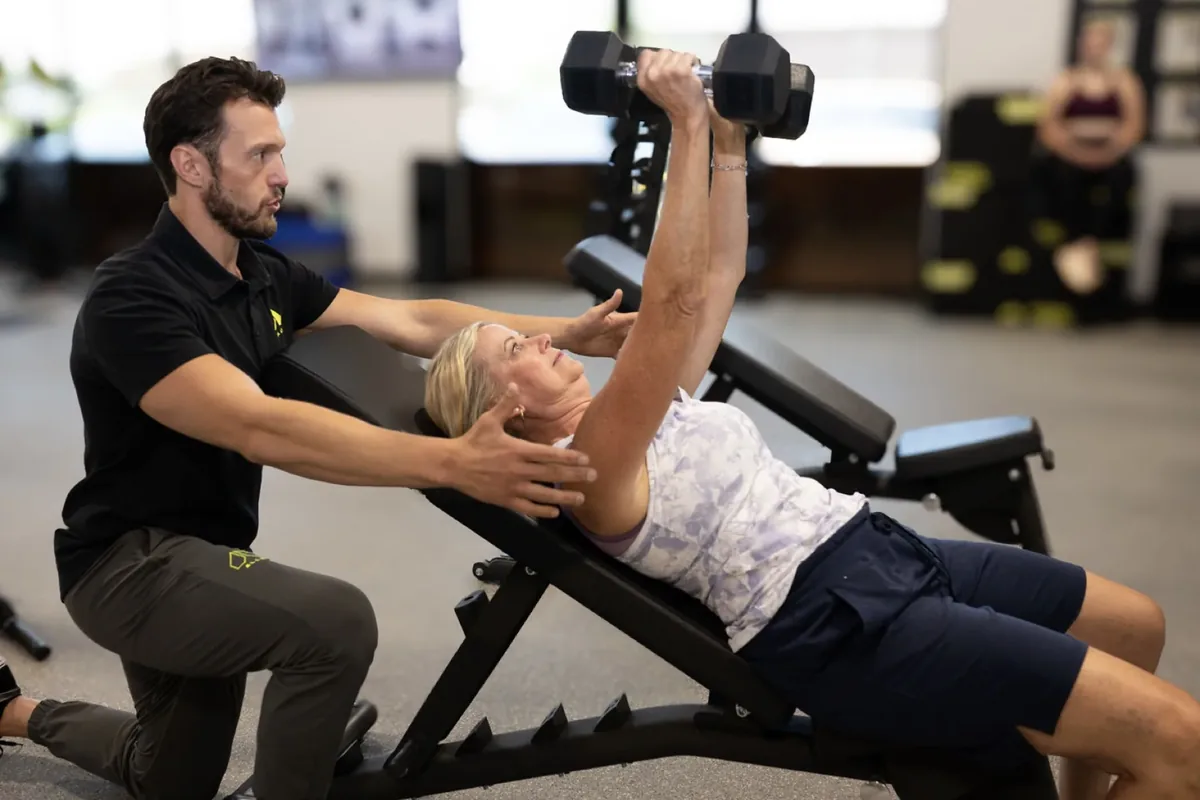
- Nobody is watching form. Small form drifts compound across months of unobserved repetition. A coach corrects the drift on the rep where it starts, which is both a safety matter and the difference between an exercise working and almost working.
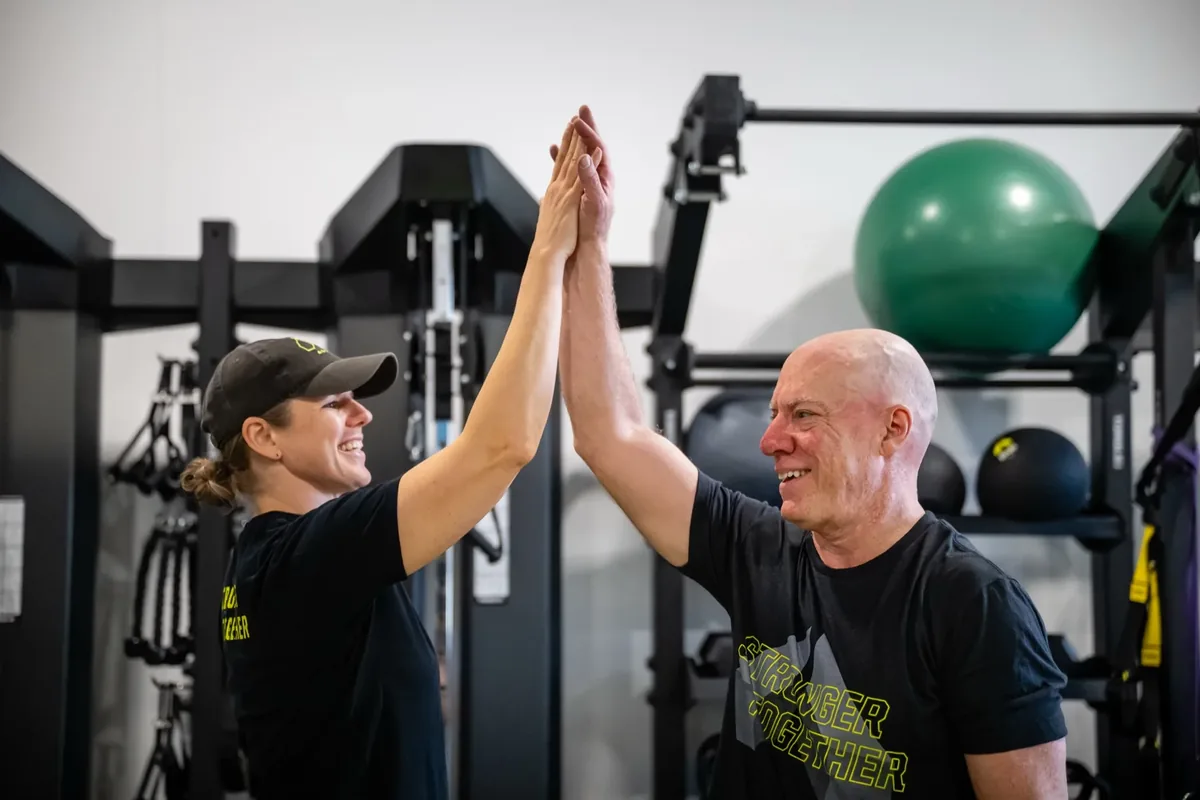
- Attendance has no witnesses. This is the quiet one. Home workouts are the easiest appointment in your life to cancel, because no one knows. Research on exercise adherence in older adults keeps finding the same thing: supervision and social connection roughly double the odds of still training a year later. The workout you keep doing beats the perfect workout you drift away from.
What does coaching actually add after 60?
Four direct answers to those four stalls: a program that progresses on schedule, loads your body can genuinely build on, eyes on every rep, and a fixed hour where five other people and a coach notice whether you came. Members who arrive from years of solo training usually feel the difference inside a month, and their first session is far gentler than the gym of their imagination.
There is also the matter of design. A good coach is not just supervising exercises; they are managing a long project: balancing the week, working around the cranky shoulder, adjusting on the day energy is low, and steering by data like the monthly InBody scan instead of guesswork. That design layer is almost impossible to provide for yourself, at any age, and it matters most in the decade when the margin for error is smallest. It is the same reason we built the case in small group training versus big-box gyms: the format is the product.
Do you have to choose one or the other?
No, and the best answer for most people is explicitly both: two coached strength sessions a week as the anchor, with home movement filling the spaces, walks, band work, stretching, the pleasant stuff. The coached hours carry the progression, loading, and accountability; the home hours carry the daily-movement habit. Each covers the other's weakness.
That division of labor also keeps the home portion fun instead of burdened. When the heavy lifting, literally, happens twice a week under supervision, your morning walk is allowed to just be a walk.
How do you test the coached side without committing blind?
The same way everything starts with us: one hour, no pressure, designed to show you exactly what the format feels like. Your first visit to our South Tempe studio on Warner and McClintock is a Starting Point Session: a conversation about what you have been doing at home (bring the details; they matter), an InBody scan to establish your real baseline, a movement assessment, and an introductory coached workout.
Keep the living room routine. Add the anchor. Book Your Complimentary VIP Consultation and see what the progression you have been missing feels like.