
Search for senior strength training and you will find two extremes: chair exercise videos gentle enough to sleep through, and influencers deadlifting their body weight at 72. Between the two sits the actually useful question almost nobody answers: what does a good strength program for an older adult really consist of?
We have strong opinions here, built from coaching adults over 60 every week. This is the honest anatomy of a program that works: what has to be in it, what is optional, and what is theater.
- Train two to three days a week on nonconsecutive days. The CDC's guidelines for adults 65+ and the NSCA's position statement for older adults agree on this.
- Heavy enough means the last rep or two of a set takes real effort, progressing toward 70–85% of your one-rep max over time.
- Across 121 randomized trials of progressive resistance training in older adults, serious adverse events were rare and none were attributed to the training (Cochrane).
- Programs that combine balance and functional work with resistance training cut fall rates by about 34%, more than any single approach (Cochrane).
- A good program starts with an assessment, progresses on paper, and measures results. The label senior matters less than those ingredients.
What has to be in the program?
- Real resistance, progressively increased. This is the non-negotiable center. Muscles and bones adapt to load, and load that never grows stops producing adaptation. The stakes are not abstract: adults lose roughly 3 to 5 percent of muscle mass per decade after 30, by some estimates up to 8 percent, and the slide accelerates after 60 (Harvard Health, UCLA Health); our guide to sarcopenia covers where that road ends. Good programs start wherever you are, then add weight, reps, or range in small, planned steps. If the dumbbells are the same in March as they were in January, the program has stopped working.
- The patterns of daily life. Sitting down and standing up (squats), picking things up (hinges), putting things overhead (presses), pulling things toward you (rows), and carrying things (loaded carries). Train the patterns your independence is built on, because those are the ones you cannot afford to lose.
- An assessment before anything. Old injuries, joint replacements, blood pressure, decades of history: a program that does not know these things is guessing. As we covered in what a first session should look like after 60, the starting point matters as much as the destination.
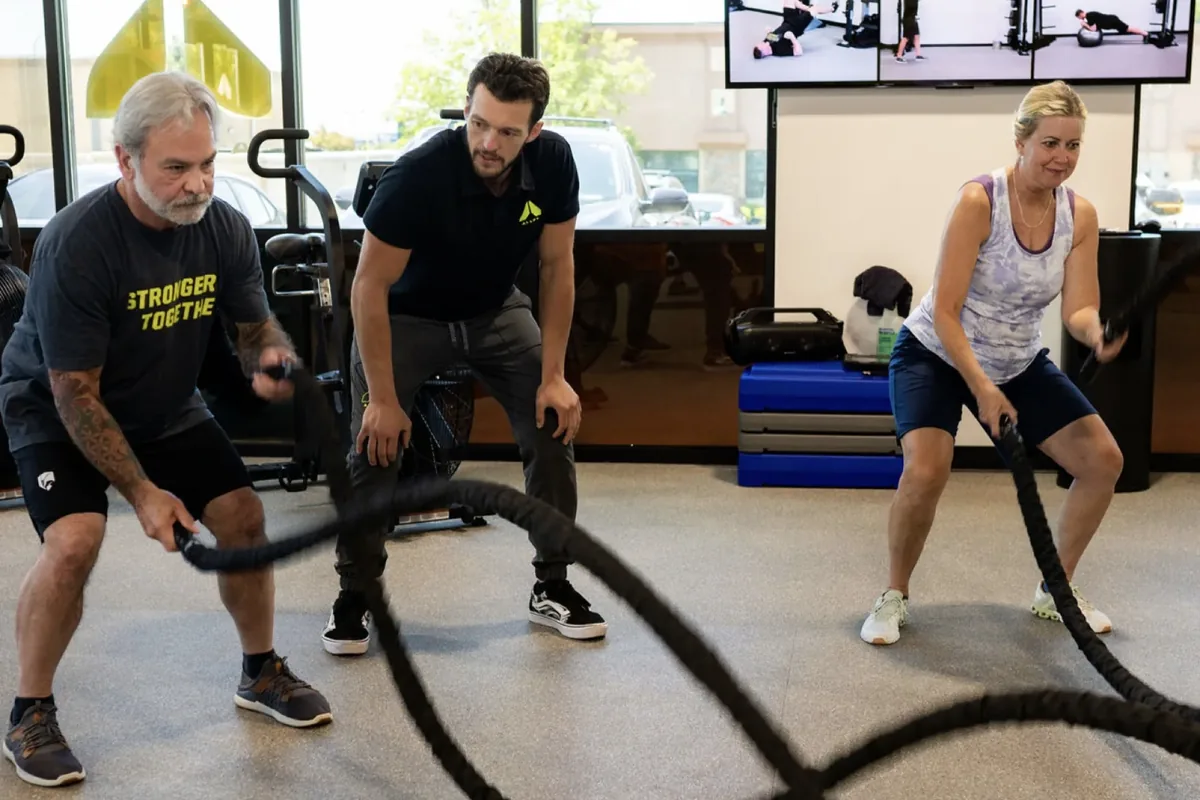
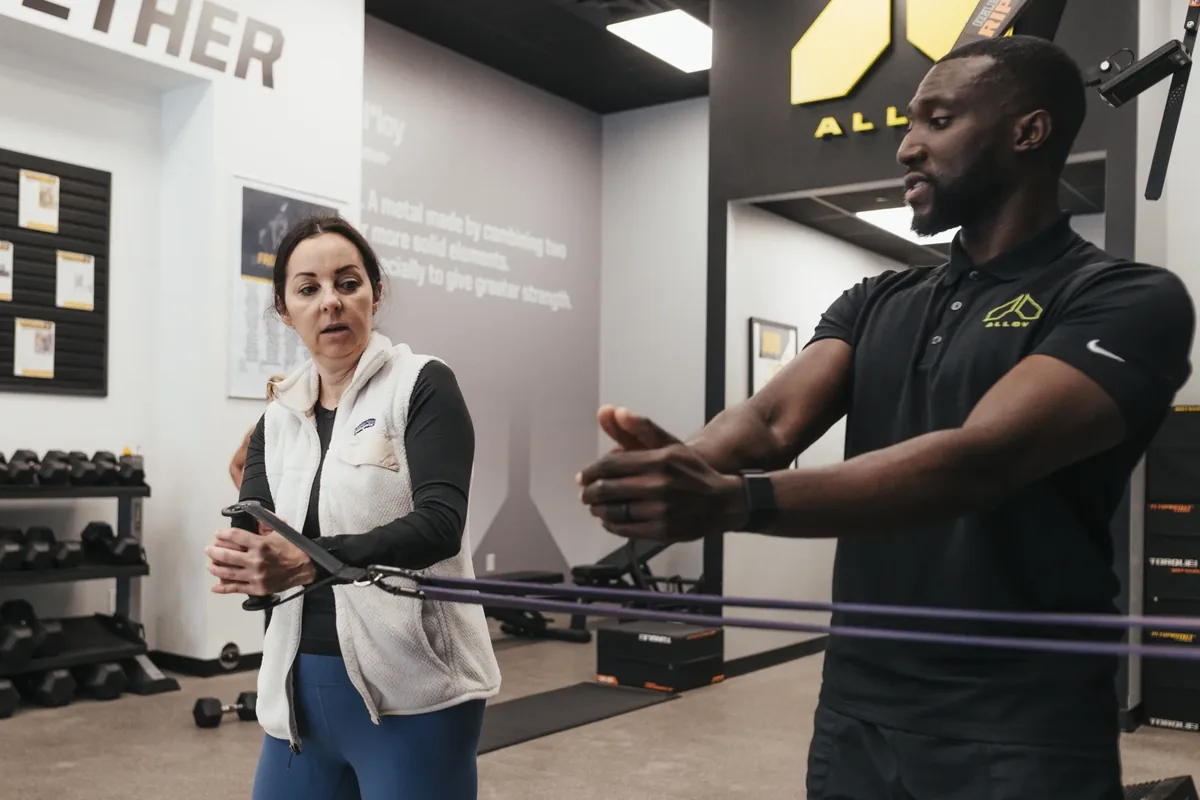
- Eyes on your form. Form quality is safety and effectiveness in one. This is the argument for coaching over videos, and for groups small enough that the coach actually sees you. Ours cap at six; we compare the formats honestly in small group versus one-on-one personal training.
- Balance woven in. Single-leg work, carries, and controlled movement train steadiness alongside strength, which is where fall resistance actually comes from.
That last point deserves its own numbers. About 1 in 4 adults 65 and older falls each year, and falls are the leading cause of injury-related death in that age group (CDC). Exercise is the best-proven countermeasure we have: across 108 randomized trials with 23,407 participants, exercise cut the rate of falls by about 23 percent, and programs that combined balance and functional work with resistance training cut it by roughly 34 percent (Cochrane Review CD012424). That is the argument for weaving balance into the strength program instead of treating them as two separate errands.
What is overrated in senior fitness?
- Chair-only everything. Chairs are a fine tool for scaling. As a permanent ceiling, they quietly promise you will never need to get up, which is precisely backwards. A good program meets you seated if necessary and then builds you out of the chair.
- Machines-only circuits. Machines have their place, but a program that never asks you to control a weight through space skips the balance and coordination that real life demands daily.
- Anything promising gentle as its main virtue. Appropriately challenging is the virtue. Gentle forever is how the drift continues with better marketing.
- Complexity. Exotic exercises photograph well. Five fundamental patterns, progressed patiently for years, is what actually builds and keeps strength.
How hard should training feel after 60?
Honestly challenging, honestly recoverable. The productive zone is effort that has your attention, with a coach making sure it is the right effort for your body on that day. The research is blunt about this: the NSCA's position statement for older adults recommends two to three sessions a week, two to three sets per exercise, progressing toward 70 to 85 percent of your one-rep max (Fragala et al., Journal of Strength and Conditioning Research). And it is safe when coached: across 121 randomized trials of progressive resistance training in older adults, serious adverse events were rare and none were attributed to the training itself (Cochrane Review CD002759).
| Phase | Rep range | How a set should feel |
|---|---|---|
| Learning the movements (weeks 1–4) | 10–15 | Comfortable, several reps left. The pattern is the point, not the load. |
| Building (months 2–3) | 8–12 | The last two reps slow down noticeably. Form stays clean. |
| Progressing (month 3 on) | 6–10 | The last rep is genuinely hard. You stop a rep or two shy, not at failure. |
Swipe to see the full table
Nobody tests a true one-rep max here; the rep ranges land you in the right zone automatically. What good programs respect is recovery: two to three sessions a week with rest between, progression in small steps, and adjustments when life or health interrupts. If you are weighing two sessions against three, our guide to sessions per week for beginners breaks down the tradeoffs. Punishing and pointless are both failures; the middle is where the years get added.
What results can you reasonably expect?
On a typical timeline: noticeably easier daily tasks and better energy inside the first month or two, measurable strength gains over the first three months, and body composition change, muscle up, often fat down, visible on monthly InBody scans across the same stretch. Beyond the numbers, members report the quieter wins first: the floor stops being a commitment, the grandkid gets picked up without a strategy meeting, the trip gets booked with confidence instead of caveats. Those are the actual outcomes; the dumbbells are just how we get there. The long-game numbers are worth knowing too: a 2022 meta-analysis in the British Journal of Sports Medicine tied 30 to 60 minutes of weekly strength work to 10 to 17 percent lower risk of all-cause mortality, cardiovascular disease, cancer, and diabetes, and roughly 40 percent lower mortality risk when paired with aerobic exercise (Momma et al., BJSM). And if you are wondering whether you have missed your window, is it too late to start strength training at 60? answers that directly: you have not.
How do you find this in Tempe?
Hold any option, including us, to the checklist above: assessment first, real progressive resistance, fundamental patterns, small enough groups that form gets watched, balance work included, and objective measurement on a sane cadence. We built our South Tempe studio around exactly that list, with sessions capped at six members and a membership that includes monthly InBody scans and ongoing guidance. For what it is worth, just showing up twice a week puts you in rare company: only 13.9 percent of Americans 65 and older met both federal activity guidelines in 2022 (CDC/NCHS). If walking into a gym at all is the hurdle, starting the gym at 65 was written for you.
The first step is a complimentary Starting Point Session: history, goals, InBody baseline, movement assessment, and a coached introductory workout, with straightforward membership answers at the end. If you are near Corona del Sol, the Kyrene corridor, or the Chandler border, Book Your Complimentary VIP Consultation. Bring your skepticism; it is welcome here.
This article is educational, not medical advice. If you have a chronic condition, a recent injury or surgery, osteoporosis, or take medication that affects blood pressure or balance, talk with your physician before starting a strength program.